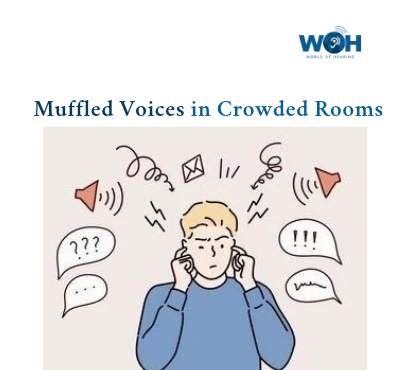
Have you ever been in a restaurant, office meeting, family gathering or crowded public place and struggled to understand what someone was saying? You can hear people talking, but their words seem unclear. You may catch a few sentences, miss important details and repeatedly ask others to speak louder or repeat themselves.
This experience is often dismissed as a normal problem caused by background noise. However, if you regularly find it difficult to understand conversations in busy environments, it may be worth paying attention to your hearing.
Difficulty following conversations in crowded places can sometimes be an early sign of hearing-related problems. It may also be associated with difficulties in processing speech when several sounds compete for your attention.
Recognising these changes early can help you understand what is happening and whether an audiology assessment is needed.
Why Do Voices Sound Muffled in Crowded Places?
In a quiet room, it is usually easier to focus on one person’s voice. There are fewer competing sounds, and you can follow the conversation without much effort.
Now imagine being in a busy restaurant. People are talking at nearby tables, utensils are clattering, music is playing and chairs are moving. Your ears and brain must work together to separate the voice you want to hear from all the surrounding sounds.
This ability is often called speech understanding in noise.
When hearing or listening abilities are affected, separating one person’s voice from background noise can become challenging. You may hear that someone is speaking but struggle to understand the actual words.
This explains why some people can follow conversations comfortably at home but find social gatherings, meetings and crowded public places much more difficult.
Early Signs You May Be Experiencing Hearing Difficulties
Hearing changes do not always begin with complete difficulty hearing sounds. Sometimes, the first noticeable changes appear during everyday conversations.
Look out for these common signs:
| Early sign | What you may notice |
| Difficulty following conversations | You hear someone speaking but cannot clearly understand their words |
| Frequently asking people to repeat themselves | You often say “What?” or “Can you say that again?” |
| Trouble hearing in restaurants | Conversations become difficult when several people are talking |
| Missing parts of group discussions | You understand one person but lose track when others join the conversation |
| Increasing television volume | You prefer the TV or mobile volume higher than other family members |
| Avoiding noisy social situations | You feel uncomfortable or tired after trying to follow conversations |
| Confusing similar-sounding words | You sometimes misunderstand words even when the speaker is nearby |
Experiencing one of these signs occasionally does not automatically mean you have hearing loss. However, if these difficulties happen regularly or begin affecting your daily communication, consider getting your hearing checked.
Common Reasons Behind Difficulty Hearing in Noisy Environments
There is no single reason why voices may sound unclear in crowded places. Several hearing-related and non-hearing-related factors can contribute to this experience.
1. Early or Age-Related Hearing Loss
Hearing loss can develop gradually. In some people, the ability to hear certain speech sounds becomes weaker before they notice a major change in everyday hearing.
Age-related hearing changes may affect the ability to distinguish speech sounds, especially when background noise is present.
For example, you may hear that someone is speaking but miss softer consonant sounds. This can make words sound incomplete or unclear.
2. Noise Exposure
Regular exposure to loud sounds can affect hearing over time. This may include loud music through headphones, machinery, traffic noise, construction sounds or high-volume entertainment.
People who work in noisy environments or frequently attend loud events may benefit from paying attention to changes in their hearing.
3. Earwax Build-Up
Excessive earwax can block the ear canal and cause symptoms such as reduced hearing, a feeling of fullness or muffled sounds.
If you notice a sudden or gradual change in hearing, earwax may be one possible explanation. However, it should not be assumed to be the cause without an appropriate examination.
Avoid inserting cotton buds or other objects deep into your ears, as this can push wax further inside or injure the ear canal.
4. Middle Ear Problems
Conditions affecting the middle ear, including fluid build-up or infections, may interfere with how sound travels through the ear.
You may experience muffled hearing, ear discomfort, a feeling of pressure or other symptoms.
An ENT examination may be required if an ear condition is suspected.
5. Difficulty Processing Speech in Background Noise
Sometimes, people report difficulty understanding speech in noisy environments even when their basic hearing test results appear normal.
This does not mean the difficulty is imaginary. Standard hearing tests and speech-in-noise tests assess different aspects of hearing and listening.
A detailed assessment may help identify whether additional evaluation of speech understanding or auditory processing is appropriate.
6. Tiredness and Reduced Attention
Listening in a crowded environment requires concentration. When you are tired, stressed or distracted, following conversations may become more difficult.
However, persistent listening difficulties should not automatically be attributed to tiredness or lack of attention. Hearing-related causes should also be considered.
Can You Have Difficulty Hearing in Crowded Places Even With Normal Hearing?
Yes, some people experience difficulty understanding conversations in noisy environments even when their conventional hearing test results are within normal limits.
A standard pure-tone hearing test checks how well you detect sounds at different frequencies and volumes. It does not always show how effectively you understand speech when several sounds are competing.
This is why an audiologist may consider additional tests, including speech-in-noise testing, depending on your symptoms and assessment findings.
For example:
- You may hear a person clearly when speaking face-to-face in a quiet room.
- You may struggle to follow the same person’s words in a busy restaurant.
- You may hear the sound of a conversation but miss specific words or sentences.
If this happens regularly, discussing your symptoms with an audiologist can help determine whether further assessment is needed.
Audiology Tests That Help Identify Hearing Difficulties
An audiology assessment helps evaluate different aspects of your hearing. The tests recommended will depend on your symptoms, medical history and initial findings.
Here are some commonly used assessments:
| Hearing test | What it evaluates |
| Pure-Tone Audiometry | Checks the softest sounds you can hear at different frequencies |
| Speech Audiometry | Evaluates how well you recognise and understand spoken words |
| Speech-in-Noise Testing | Assesses your ability to understand speech when background noise is present |
| Tympanometry | Evaluates the movement of the eardrum and the functioning of the middle ear |
1. Pure-Tone Audiometry
This test measures your ability to hear sounds at different pitches and volumes.
You usually wear headphones and respond whenever you hear a tone. The results help create an audiogram, which shows your hearing sensitivity in each ear.
2. Speech Audiometry
Speech audiometry evaluates how well you can recognise and understand spoken words.
It provides information about speech perception and may be performed alongside pure-tone testing.
3. Speech-in-Noise Testing
This assessment is particularly relevant for people who struggle to understand conversations in restaurants, meetings or crowded public spaces.
You may be asked to listen to words or sentences while background noise is played. Your responses help the audiologist understand how effectively you can recognise speech in challenging listening conditions.
4. Tympanometry
Tympanometry checks how the eardrum responds to changes in air pressure. It can help identify certain middle-ear problems that may affect hearing.
Not everyone requires every test. The audiologist will recommend suitable assessments based on your individual needs.
When Should You Visit an Audiologist?
You do not have to wait until hearing difficulties become severe before seeking an assessment.
Consider consulting an audiologist if:
- You frequently struggle to understand conversations in crowded places.
- You regularly ask people to repeat themselves.
- You find phone conversations increasingly difficult.
- You have trouble following discussions during office meetings.
- Your family members notice that you keep increasing the television volume.
- You experience persistent muffled hearing or other changes in your listening ability.
An audiologist can assess your hearing, explain the results and guide you on suitable next steps.
Important: Sudden hearing loss, particularly when it develops over hours or a few days, needs urgent medical evaluation. Do not wait for a routine appointment or assume that it is due to earwax. Ear pain, discharge, significant dizziness or one-sided hearing changes should also be medically evaluated.
Simple Ways to Make Conversations Easier in Crowded Places
If you find noisy environments challenging, a few practical changes may make communication easier.
| Situation | What you can try |
| Restaurant or café | Choose a quieter table away from speakers, kitchens or busy areas |
| Family gathering | Sit closer to the person speaking |
| Office meeting | Request a quieter seating arrangement and avoid unnecessary background noise |
| Group conversation | Ask people to speak one at a time where possible |
| Phone conversation | Move to a quieter location before taking the call |
| Difficult conversation | Politely ask the speaker to repeat or rephrase the sentence |
These adjustments can help reduce listening effort, but they do not replace a hearing assessment when difficulties are persistent.
Can Hearing Aids Help With Understanding Speech in Crowded Places?
For people with hearing loss, appropriately selected and fitted hearing aids may help improve access to speech and everyday sounds.
Modern hearing aids may include features such as directional microphones and noise-management settings. Depending on the device and the user’s hearing profile, these features can help make speech easier to follow in certain noisy environments.
However, hearing aids do not completely remove background noise or guarantee that every conversation will become clear.
The right device depends on several factors, including:
- The type and degree of hearing loss
- Hearing test results
- Daily communication requirements
- Comfort and fitting preferences
- Listening environments and lifestyle
A professional hearing assessment is important before choosing a hearing aid. Avoid selecting a device only because it is popular, inexpensive or recommended by someone else.
You can explore available Widex hearing aids in Wakad to learn more about hearing aid options. The most suitable device should always be selected according to individual hearing needs.
Hearing Care and Audiology Support at World of Hearing Clinic, Pune
Difficulty understanding conversations in crowded places can affect more than just your ability to hear. It may influence social interactions, workplace communication, family conversations and confidence in everyday situations.
At World of Hearing Clinic, Pune, individuals can seek hearing care guidance and assessment based on their listening concerns. The clinic provides hearing-related services, including diagnostic assessments, hearing aid fitting and maintenance, and speech and language assessment and therapy.
If you are looking for an audiologist in Wakad, an appropriate hearing assessment can help you understand your hearing abilities and identify possible next steps.
You can also learn more about hearing aid care in Wakad and the hearing care services available at the Hearing Aid Clinic in Wakad.
If you have noticed persistent difficulty understanding speech in noisy environments, do not ignore the change. Contact World of Hearing Clinic to enquire about an appropriate hearing assessment.
Frequently Asked Questions
1. Why can I hear people talking but not understand their words in crowded places?
This may happen when background noise makes it difficult to separate speech from surrounding sounds. Hearing loss, speech-in-noise difficulties and other listening-related factors may contribute. An audiology assessment can help identify possible reasons.
2. Is difficulty hearing in noisy places an early sign of hearing loss?
It can be an early sign of hearing-related difficulties, including certain types of hearing loss. However, it is not enough to confirm a diagnosis. A hearing assessment is needed to understand the cause.
3. Can I have trouble understanding speech even if my hearing test is normal?
Yes. Some people experience difficulty understanding speech in noisy environments despite having normal results on conventional pure-tone testing. Additional assessments, such as speech-in-noise testing, may provide useful information.
4. Which hearing test is best for difficulty understanding conversations in noise?
Speech-in-noise testing is designed to assess how well a person understands speech when background noise is present. An audiologist may recommend it along with other hearing tests based on the individual’s symptoms.
5. Can hearing aids improve speech understanding in crowded places?
Appropriately selected hearing aids may help people with hearing loss understand speech more comfortably in certain noisy situations. The results vary from person to person, and proper assessment, fitting and follow-up are important.
Medical Disclaimer
This blog is intended for informational purposes only. The information shared here should not be considered a diagnosis or a substitute for individual medical evaluation. Hearing difficulties can have different causes, and assessment requirements may vary from person to person. Seek appropriate medical attention if you experience sudden hearing changes or persistent symptoms.